What Is Smart Film? How It Works, Benefits & Uses
Smart film is an electrically controlled privacy film applied to glass to allow it to switch between a transparent state and a frosted privacy state. Most switchable smart film uses PDLC, or Polymer Dispersed Liquid Crystal, technology. When electricity is supplied, the liquid crystals align and allow more light to pass through. When the power is switched off, they scatter light and make the glass appear frosted.
This makes smart film useful for spaces that need privacy at certain times without permanently covering glass with curtains, blinds or frosted film.
It can be used in offices, meeting rooms, clinics, homes, retail spaces and other interiors where flexible privacy is useful.
What Is Smart Film?
Smart film, sometimes called switchable smart film, privacy smart film, PDLC film or smart glass film, is a thin electrically controlled film designed for glass surfaces.
Unlike conventional frosted film, which stays frosted all the time, smart film can change between two states:
- Clear or transparent when switched on
- Frosted or private when switched off
This gives users more control over how a glass partition, window or door is used.
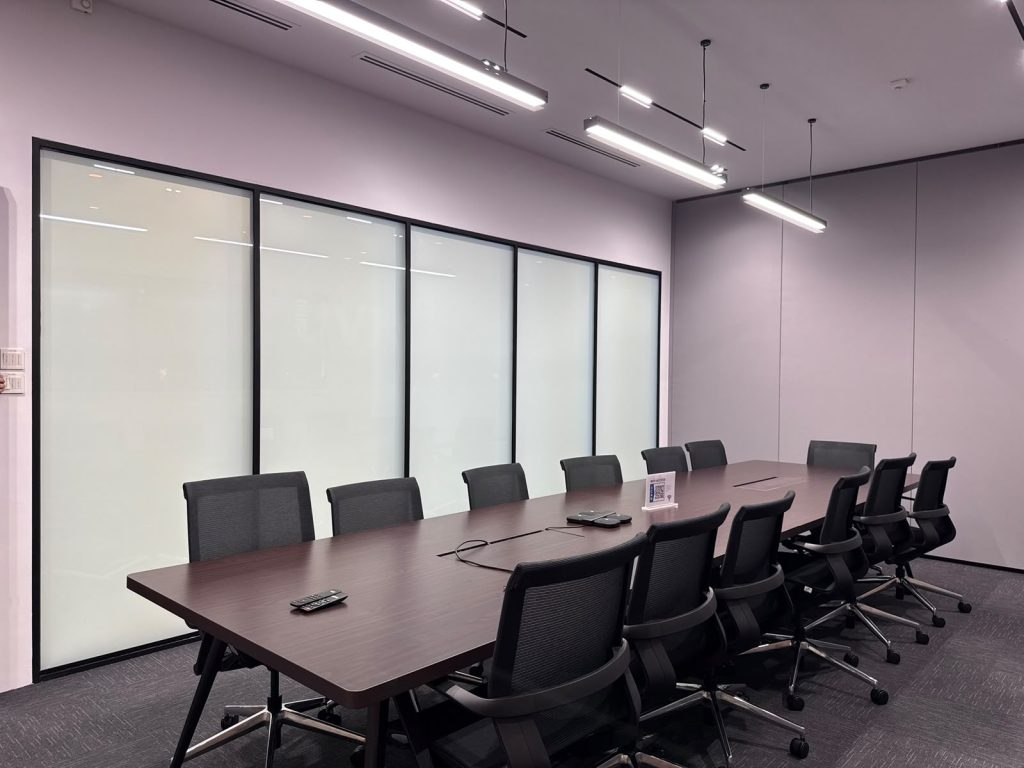
For example, an office meeting room can remain visually open when it is not in use. When a confidential meeting begins, the smart film can be switched to privacy mode without closing blinds or curtains.
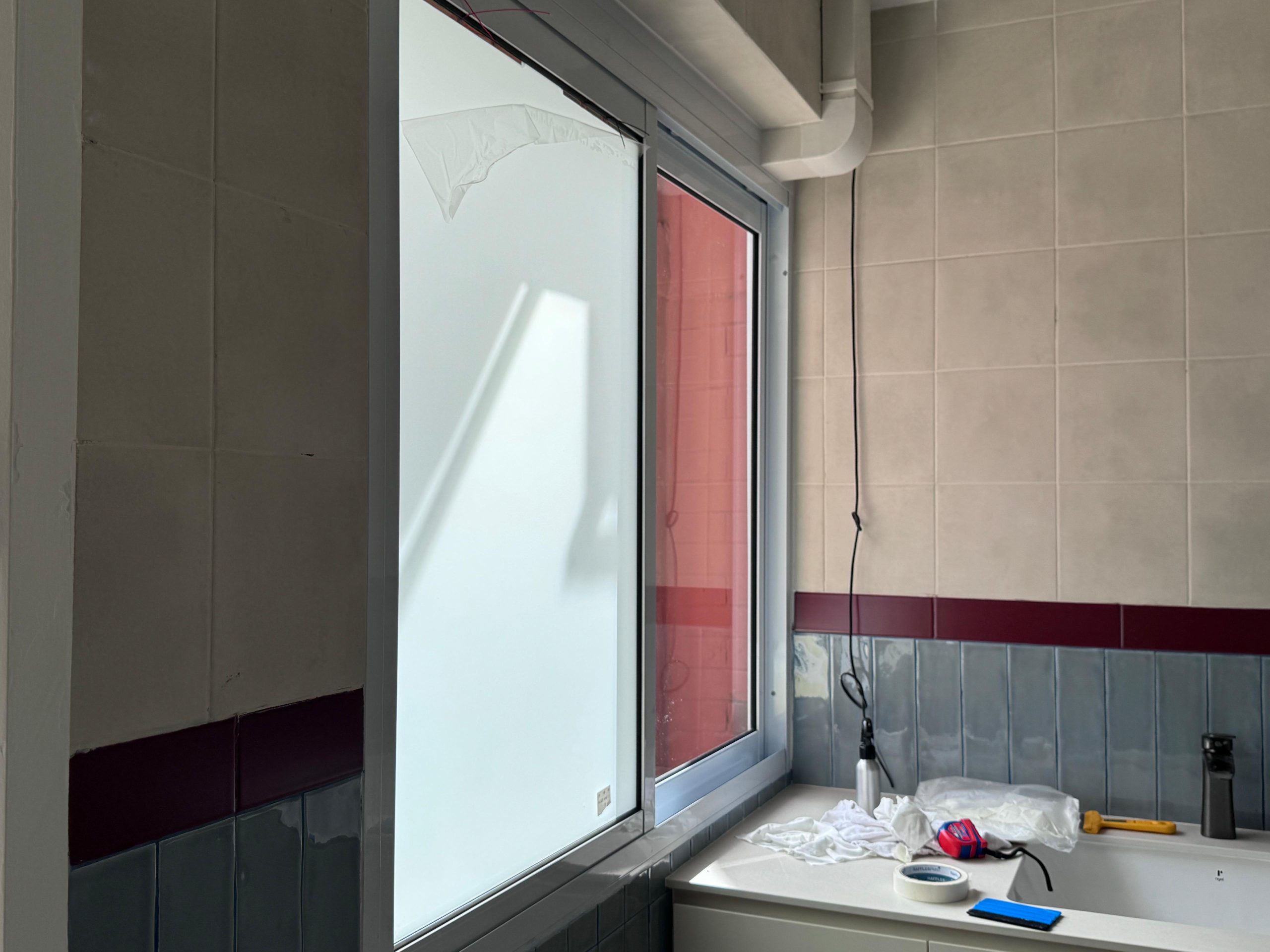
Because certain types of smart film can be installed directly onto suitable existing glass, it can also be considered for retrofit projects where replacing the entire glass panel is unnecessary.
How Does Smart Film Work?
Most smart film used for switchable privacy works using PDLC technology.
PDLC stands for Polymer Dispersed Liquid Crystal.
Inside the film are microscopic liquid crystal droplets contained within a polymer layer.
The appearance of the glass changes depending on whether an electrical field is applied.
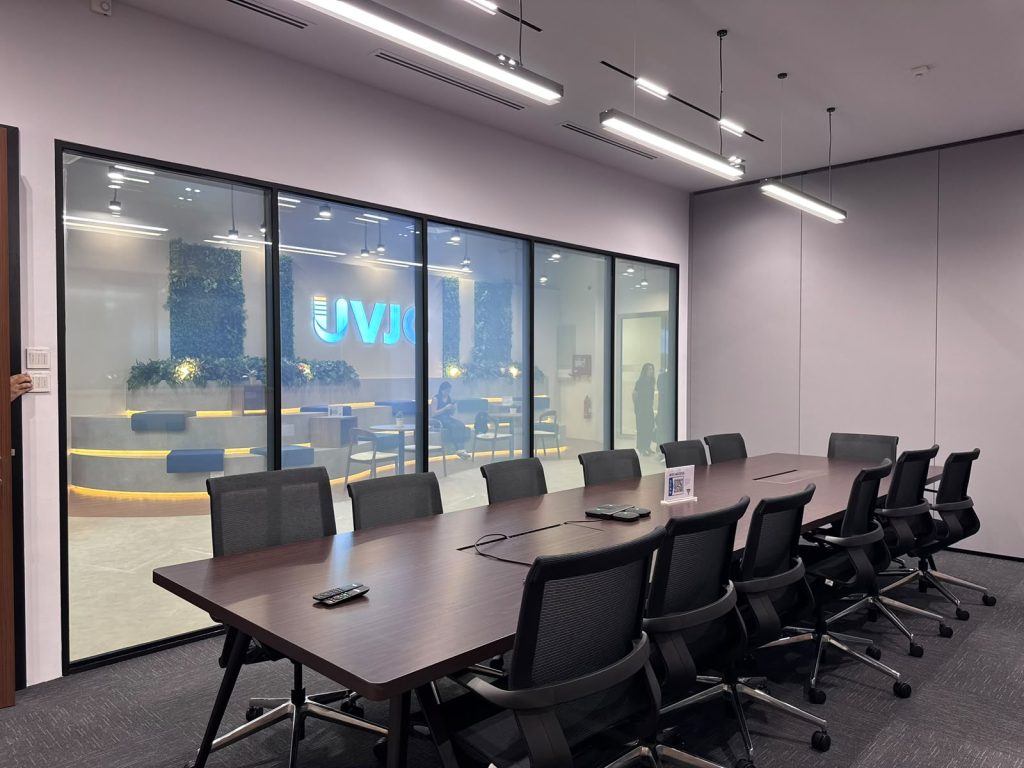
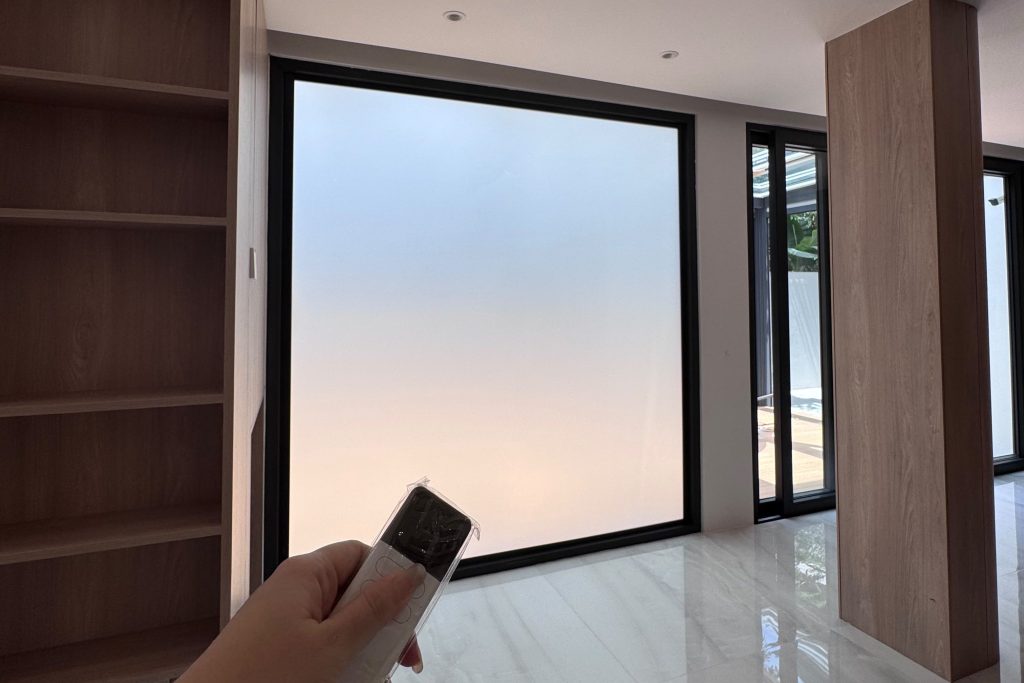
When the power is off
When no electricity is supplied, the liquid crystal molecules are arranged randomly.
Light passing through the film is scattered in different directions.
Because the light is scattered rather than travelling directly through the glass, the film appears:
- Frosted
- Milky
- Translucent
- Private
This reduces clear visibility through the glass.
However, privacy mode does not necessarily mean complete blackout.
Light can still pass through the film, which means the room can remain bright even when direct visibility is reduced.
When the power is on
When electricity is supplied, the liquid crystals align.
This allows more light to pass directly through the film.
The glass then changes to its clearer state.
This switching effect is what makes smart film useful for spaces that need both openness and privacy at different times.
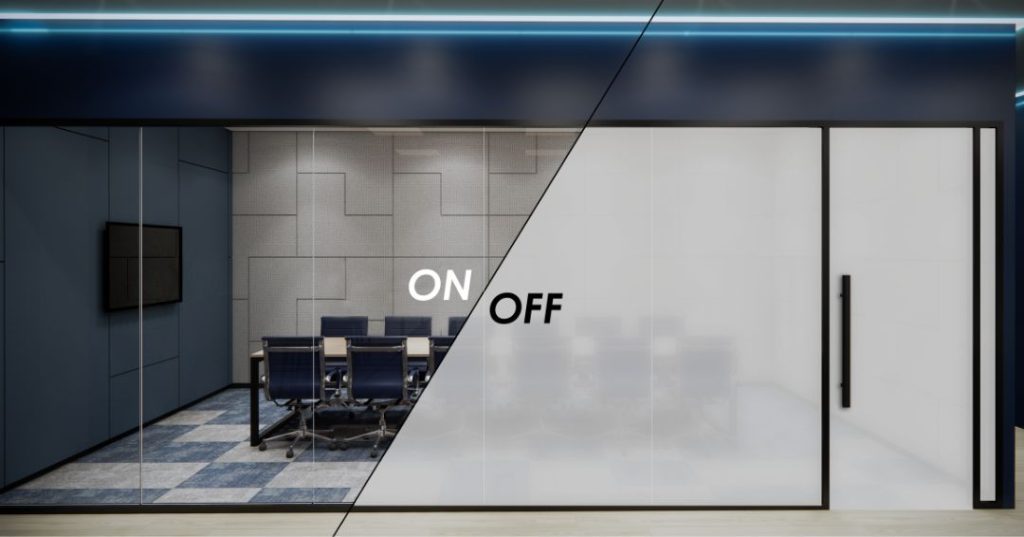
Smart Film: Power On vs Power Off
| Smart Film State | Appearance | Typical Use |
|---|
| Power On | More transparent / clear | Open meetings, general visibility, brighter visual connection |
| Power Off | Frosted / opaque-looking | Privacy meetings, confidential discussions, private rooms |
One detail worth understanding before installation is that the clear state of smart film may still have some visible haze compared with untreated glass.
The exact level of clarity depends on the film specification, glass condition, installation quality, lighting and viewing angle.
For that reason, customers should assess a physical sample or completed installation rather than assuming the switched-on film will look identical to ordinary clear glass.
What Are the Benefits of Smart Film?
Smart film is mainly used because it allows one glass surface to serve two purposes: openness when desired and privacy when required.
1. Privacy on demand
The main benefit is controllable privacy.
Instead of keeping a meeting room permanently frosted, users can switch between open and private states according to the situation.
This is useful for:
- Meetings
- Interviews
- HR discussions
- Medical consultations
- Private calls
- Management rooms
- Residential privacy
2. Keeps the space visually open
Permanent blinds and opaque partitions can make an interior feel more enclosed.
Smart film allows glass partitions to remain visually connected when privacy is not needed.
This is particularly useful in modern offices where businesses want:
- Natural light
- Open sightlines
- Glass meeting rooms
- Flexible private spaces
3. Can reduce reliance on curtains and blinds
In suitable applications, smart film can reduce the need for conventional privacy coverings.
This can create a cleaner appearance, especially on:
- Glass partitions
- Meeting-room walls
- Glass doors
- Interior windows
It can also remove the need to manually open and close blinds every time privacy is required.
4. Suitable for existing glass in many retrofit applications
Self-adhesive PDLC smart film can be installed directly onto suitable existing glass.
This can make it practical for offices or properties that already have glass partitions but want switchable privacy without replacing all the glass.
Whether the existing glass is suitable should still be checked before installation.
5. Helps maintain natural light
The privacy state scatters light rather than simply covering the glass with an opaque solid surface.
As a result, spaces can retain daylight while reducing direct visibility.
This is useful in meeting rooms, clinics and interiors where natural light is importante privacy is required.
6. Clean and modern appearance
Smart film removes the visual clutter associated with curtain tracks, blinds and other mechanical privacy systems.
For commercial interiors, this can support a cleaner and more contemporary design.
Where Can Smart Film Be Used?
Smart film is most useful where glass is desirable but permanent transparency is not.
Office meeting rooms
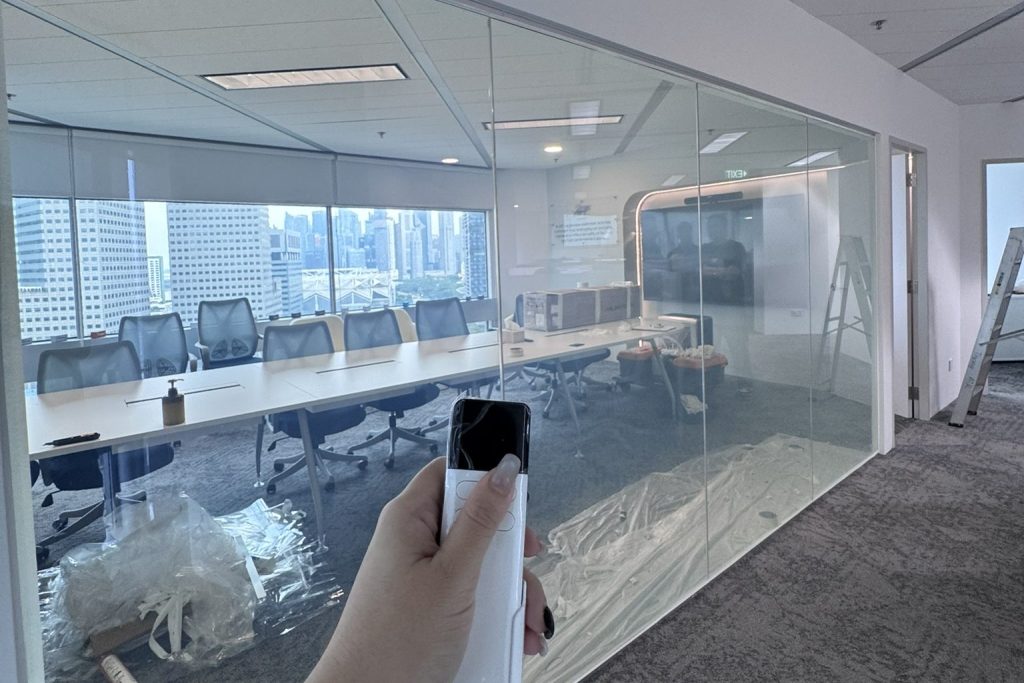
One of the most common applications is glass meeting rooms.
The room can remain transparent when empty and switch to privacy mode during:
- Management meetings
- HR discussions
- Interviews
- Client meetings
- Confidential conversations
This allows businesses to maintain the open appearance of glass without sacrificing privacy when it is actually needed.
Director and management rooms
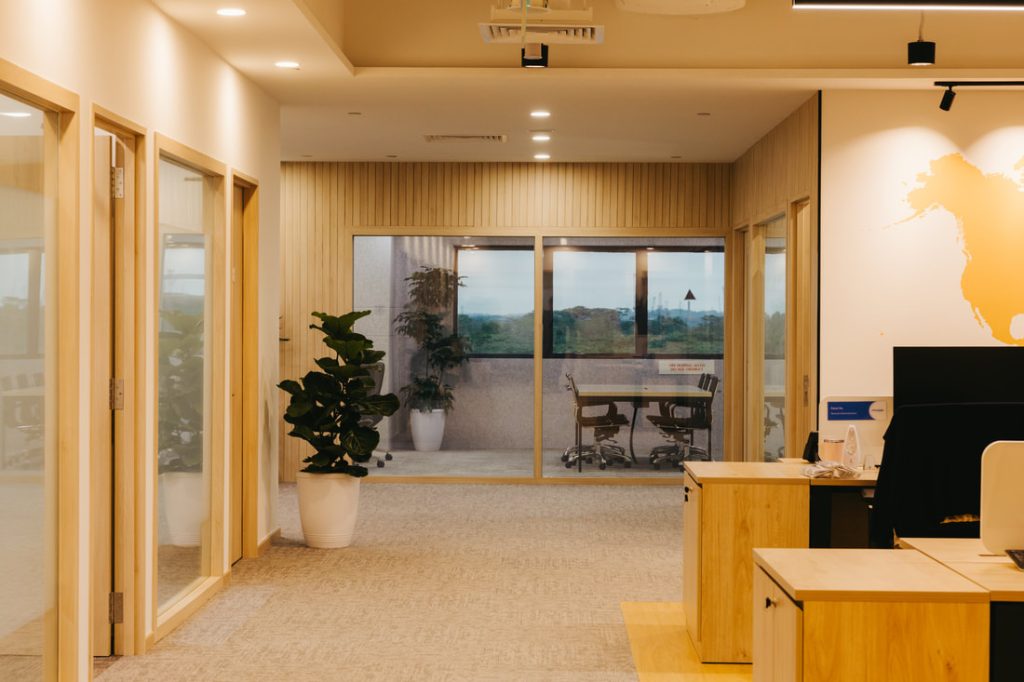
Glass director rooms can create openness while still giving management the option to create visual privacy when required.
Smart film can be particularly useful when permanent frosted glass would make the room feel unnecessarily closed throughout the day.
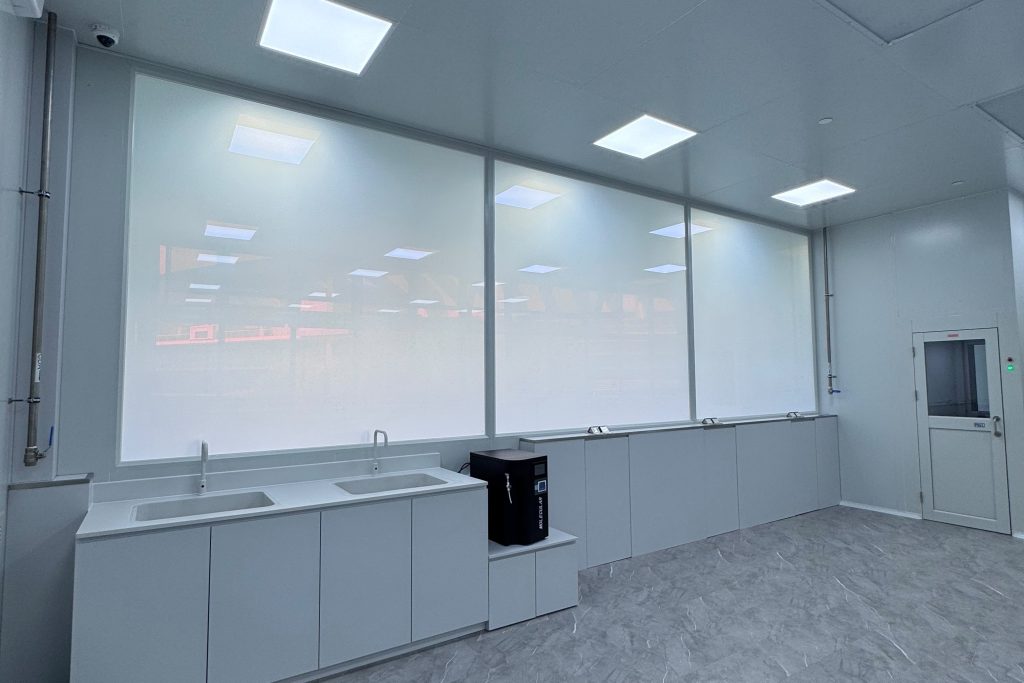
Clinics and consultation rooms
Privacy is particularly important in healthcare and consultation environments.
Smart film may be considered for:
- Consultation rooms
- Treatment rooms
- Internal glass partitions
- Observation areas
The exact privacy, hygiene and regulatory requirements should be considered according to the application.
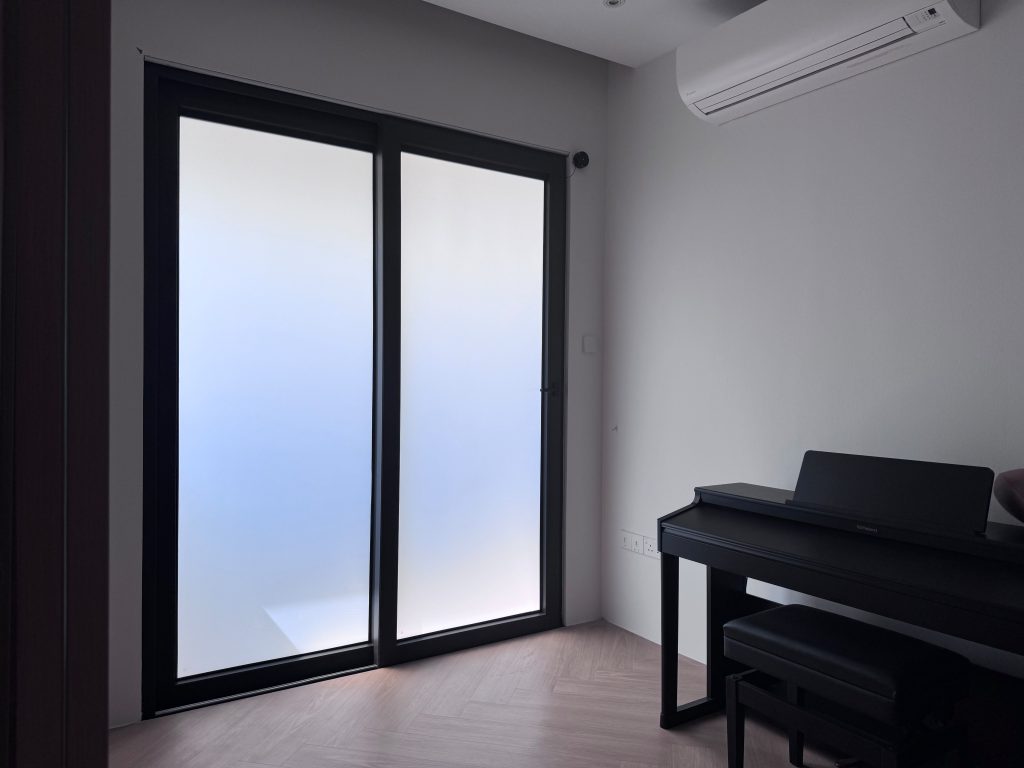
Residential spaces
Smart film can also be used in homes.
Possible applications include:
- Bathroom glass
- Bedroom partitions
- Study rooms
- Glass doors
- Internal windows
- Home offices
It is most useful where homeowners want to keep the openness of glass but occasionally need privacy.
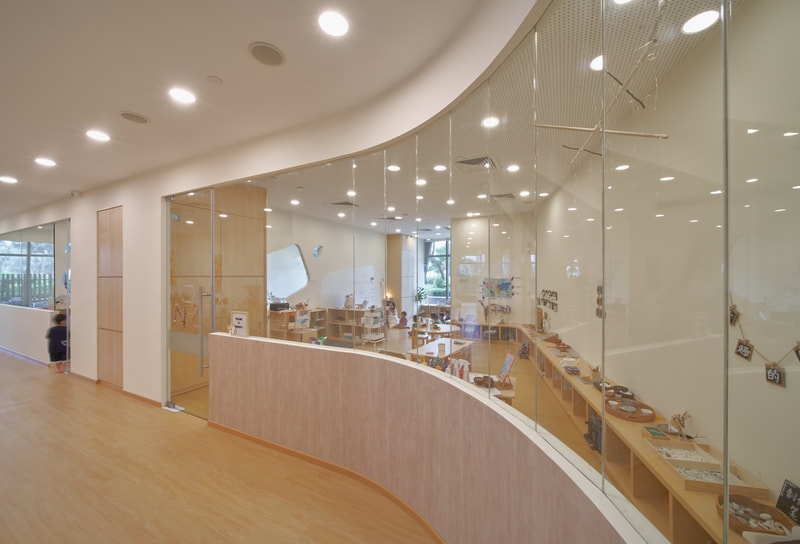
Retail and commercial spaces
Retail stores, showrooms and commercial interiors may use smart film for flexible visibility.
For example, a glass area can remain clear during normal operations and become private for:
- Internal meetings
- Staff areas
- Product presentations
- Private appointments
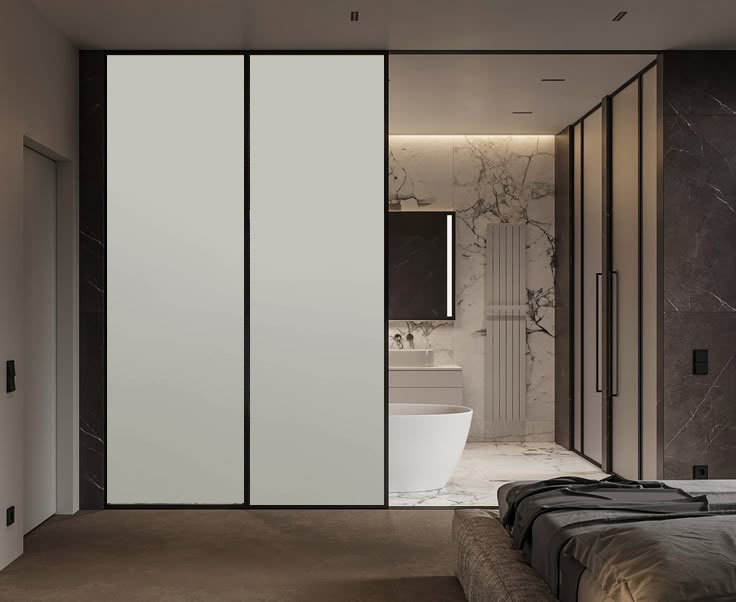
Hospitality and other interior spaces
Smart film may also be considered for hotels, serviced apartments and other interiors where adjustable privacy is part of the design.
Suitability depends on the glass type, electrical requirements, environment and intended use.
What Should You Consider Before Installing Smart Film?
Smart film installation should not begin with only the question:
“How much film do I need?”
The condition of the glass, electrical planning and installation environment matter as well.
1. Existing glass condition
The glass should be inspected before installation.
Things to check include:
- Damage
- Chips
- Cracks
- Surface contamination
- Existing films
- Uneven surfaces
Smart film depends on a clean and suitable glass surface for proper installation.
Installing it over unsuitable or damaged glass can affect the result.
2. Glass size and shape
The dimensions of each glass panel need to be measured accurately.
Large panels, unusual shapes, glass doors and sections with cut-outs may require additional planning.
Electrical connection points also need to be considered when deciding the final film size.
3. Power supply location
Smart film requires electrical power to switch states.
Electrical planning should therefore happen before installation.
The project should consider:
- Where the power supply will be located
- Where wires will run
- Where transformers or controllers will be placed
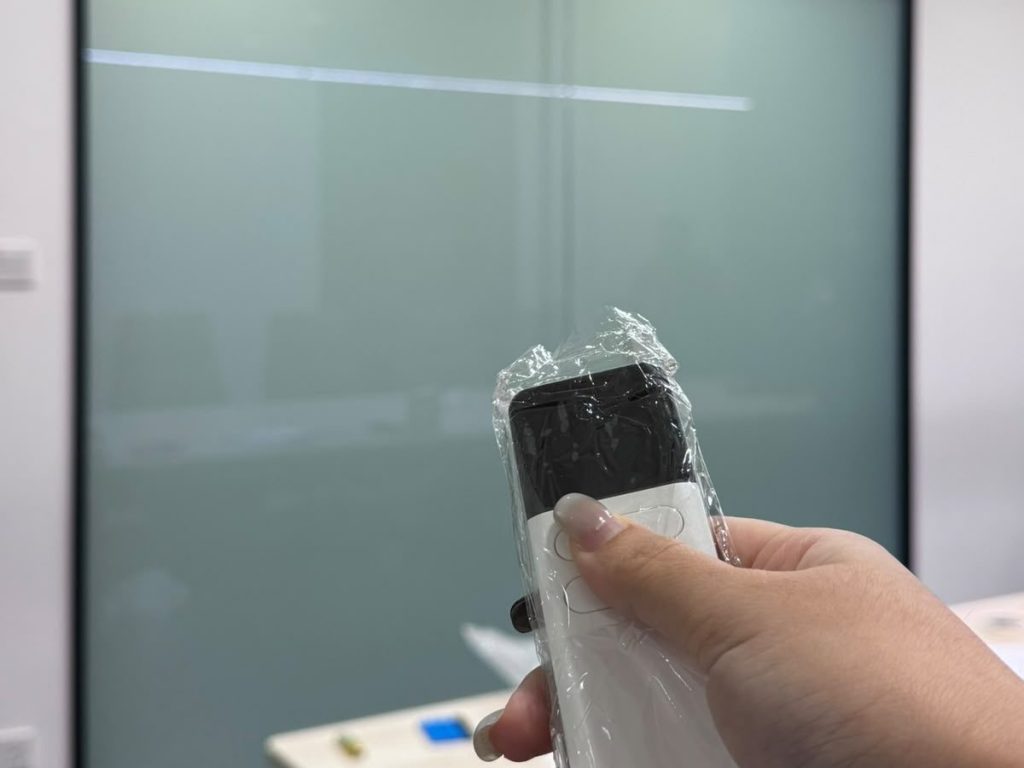
- How the system will be switched
- Whether wiring can be concealed
Poor planning can result in visible wiring around an otherwise clean glass installation.
Where new wiring or modifications to the electrical installation are required, the work should be carried out or supervised by an appropriately Licensed Electrical Worker in Singapore.
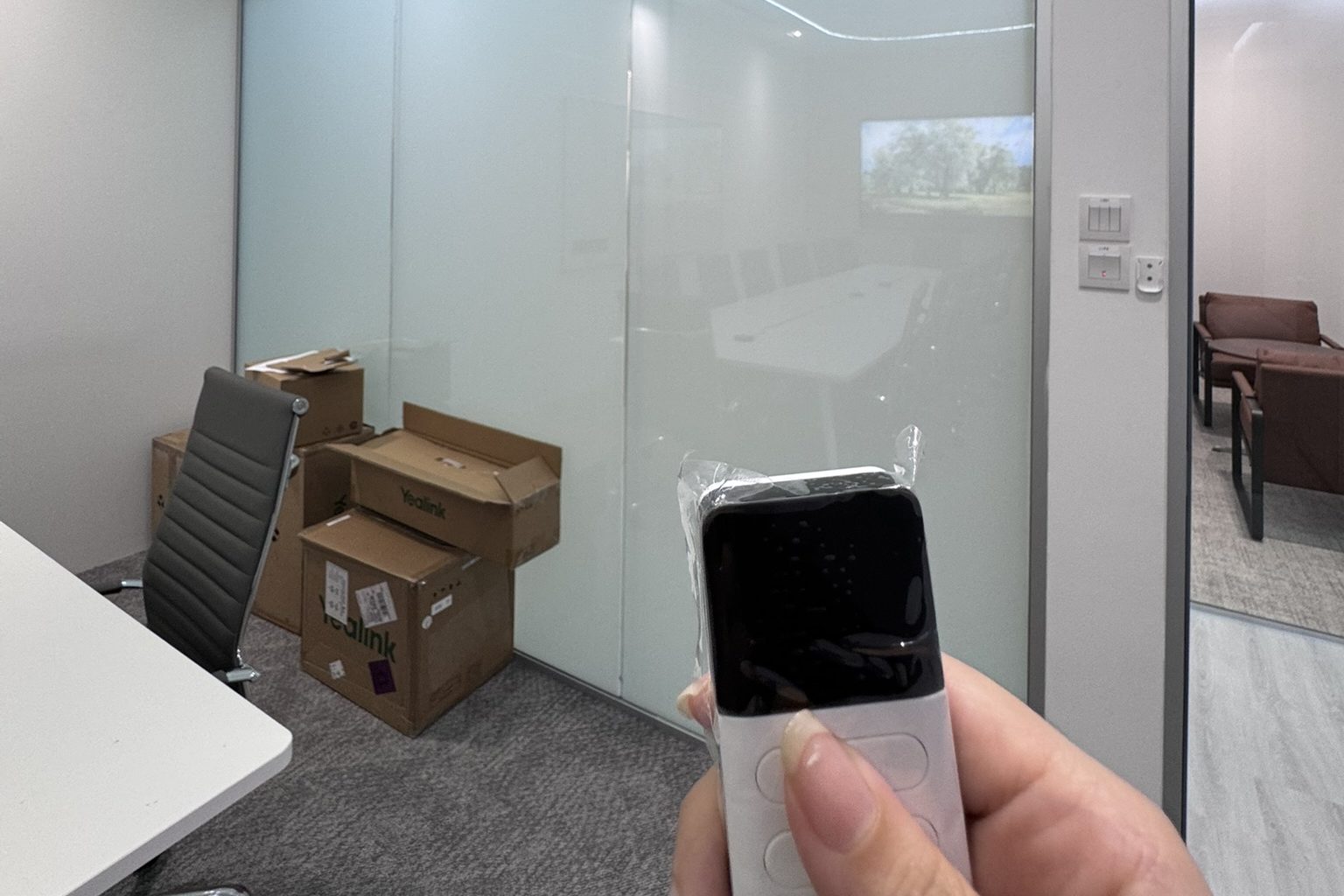
4. Control method
Depending on the selected system, smart film may be operated through controls such as:
- Wall switches
- Remote controls
- Automated control systems
Available control methods depend on the product and project setup.
The preferred method should be discussed before the electrical works are finalised.
5. Privacy expectation
Customers should be clear about what they expect from privacy mode.
PDLC smart film is designed to reduce direct visibility by creating a frosted appearance.
It is not the same as:
- Blackout blinds
- Solid walls
- Soundproof partitions
Smart film controls visual privacy.
If acoustic privacy is also required, other design measures may be necessary.
This distinction is particularly important for meeting rooms and consultation spaces.
6. Clear-state appearance
Smart film becomes significantly more transparent when powered, but some haze may remain.
Before installation, consider:
- Viewing distance
- Lighting
- Whether the glass is mainly viewed straight-on or from an angle
- The required level of optical clarity
For locations requiring completely unobstructed display-glass clarity, the suitability should be assessed carefully.
7. Indoor or exposed installation conditions
The installation environment can affect product selection and detailing.
Factors may include:
- Direct sunlight
- Moisture
- Heat
- Edge exposure
- Cleaning conditions
- Glass orientation
The correct smart film specification should be selected according to the intended application rather than assuming one film is suitable everywhere.
Can Smart Film Be Installed on Existing Glass?
Yes, self-adhesive smart film can be applied to suitable existing glass, making it one of the main options for retrofitting conventional glass into switchable privacy glass.
This is particularly useful for offices with existing:
- Glass meeting rooms
- Glass partitions
- Director rooms
- Consultation rooms
- Glass doors
Instead of removing the existing glass, the film can be applied directly to the surface and connected to the required electrical system.
However, the glass should first be assessed for condition, dimensions, installation environment and electrical access.
Not every existing glass application should automatically be assumed suitable.
Smart Film vs Smart Glass: What Is the Difference?
Smart film and smart glass can provide a similar clear-to-private effect, but the construction and installation method are different.
| Smart Film | Smart Glass |
| Applied to suitable existing glass | PDLC layer incorporated into a glass assembly |
| Useful for retrofit projects | Often considered for new glass installation or replacement |
| Existing glass may remain in place | Existing glazing normally needs to be replaced if retrofitting |
| Film edges and electrical connections require careful installation | Switching layer is protected within the glass construction |
| Good option when glass is already installed | Good option when glass is being replaced or newly specified |
The better choice depends on the project.
If the existing glass is in good condition and replacement is unnecessary, smart film may be a practical solution.
If the project is already replacing the glass, smart glass may be worth considering instead.
Is Smart Film Suitable for Your Space?
Smart film is worth considering when you want:
- Glass visibility most of the time
- Privacy only when needed
- A cleaner alternative to blinds
- A solution for existing glass
- More flexible meeting rooms
- Visual privacy without permanently blocking light
It may be less suitable when the main requirement is:
- Complete blackout
- Acoustic isolation
- Maximum optical clarity identical to untreated glass
- Privacy without any electrical system
The best solution depends on what problem the glass actually needs to solve.
A meeting room that needs occasional visual privacy has different requirements from an external window that needs strong solar control or a room requiring high acoustic isolation.
Understanding the requirement first makes it easier to decide whether smart film, smart glass, frosted film, curtains or another solution makes more sense.
Frequently Asked Questions About Smart Film
What is smart film?
Smart film is an electrically controlled film applied to glass to provide switchable privacy. Most smart film uses PDLC technology. With the power off, the liquid crystals scatter light and make the film appear frosted. When electricity is supplied, the crystals align and the glass becomes more transparent.
How does smart film work?
Smart film contains liquid crystals suspended within a polymer layer. When the power is off, the crystals are randomly arranged and scatter incoming light, creating a frosted appearance. When electricity is applied, the crystals align, allowing more light to travel through the film and making the glass appear clearer.
Can smart film be installed on existing glass?
Yes. Self-adhesive PDLC smart film can be applied to suitable existing glass. This makes it useful for retrofitting meeting rooms, office partitions, glass doors and other interiors without necessarily replacing the glass. The condition, dimensions and installation environment of the existing glass should be checked first.
Does smart film become completely clear?
Smart film becomes much more transparent when powered, but it may retain some haze compared with ordinary untreated glass. The result depends on the film specification, lighting, viewing angle and installation. A physical sample is useful when optical clarity is an important consideration.
Does smart film provide soundproofing?
Smart film is primarily a visual privacy solution. It does not by itself make a glass partition soundproof. If a meeting room needs both visual and acoustic privacy, the glass system, seals, doors, partitions and other acoustic measures should be considered separately.
Where is smart film commonly used?
Smart film can be used on suitable glass in office meeting rooms, director rooms, clinics, consultation rooms, homes, retail spaces and other commercial interiors. It works particularly well where users want the openness of glass with the ability to create privacy when needed.
What should I check before installing smart film?
Check the existing glass condition, glass dimensions, electrical supply, wiring route, preferred control method, installation environment and required privacy level. It is also important to understand that PDLC smart film provides visual privacy rather than complete blackout or acoustic isolation.
Final Thoughts: Is Smart Film the Right Privacy Solution?
Smart film gives existing glass a useful second function.
Instead of choosing permanently transparent glass or permanently frosted glass, users can move between openness and privacy according to how the space is being used.
Its biggest strengths are:
- Privacy on demand
- Flexible use of glass spaces
- Retrofit potential
- Natural-light retention
- Clean interior appearance
However, good results depend on choosing the right application and planning the installation properly.
Glass condition, electrical access, wiring, control method and privacy expectations should all be reviewed before installation.
Smart Glass Solution provides smart film and switchable privacy solutions for offices, homes, clinics and commercial spaces in Singapore.
If you are considering smart film for existing glass, our team can review the application, glass condition and privacy requirements before recommending a suitable solution.
Contact Smart Glass Solution to discuss smart film installation for your space.